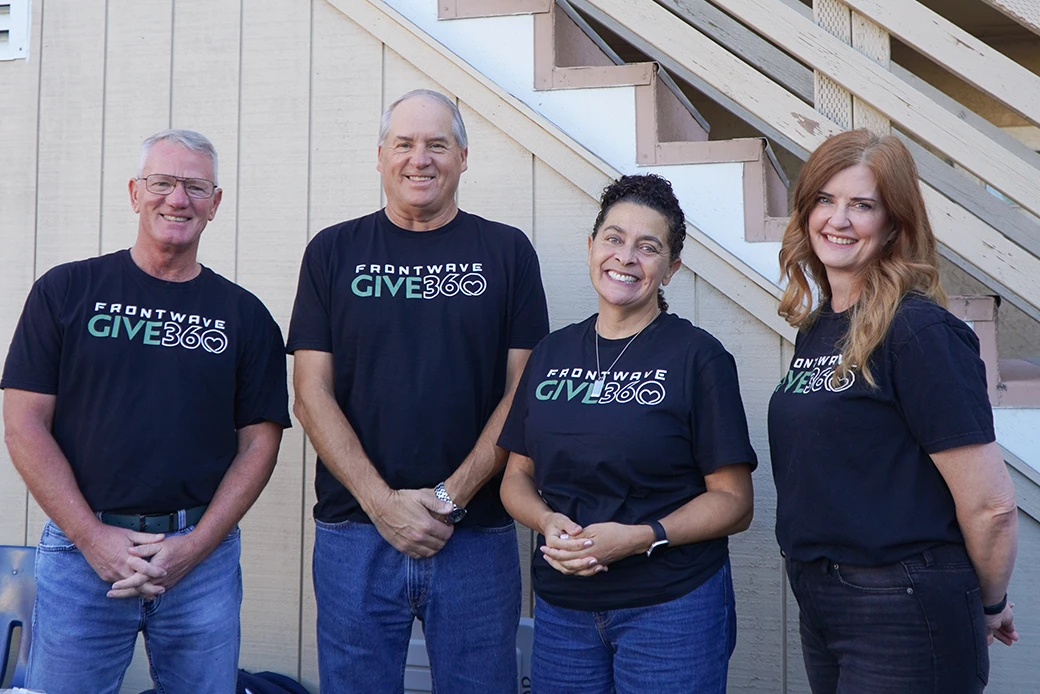
Showing Up for Our Communities
Through Frontwave Give360, we support local organizations and causes that strengthen the communities we call home.
Through Frontwave Give360, we support local organizations and causes that strengthen the communities we call home.

Use the value you've built to renovate, consolidate, or fund what's next.
Lending options tailored for hardworking business owners like you.
Insights on money, life, and the communities we serve.
Turning compassion into action through grants, scholarships, and support for local nonprofits.

From buying your first car to refinancing for a better rate, this guide breaks down how auto loans work, how to get a fair rate, and how to avoid costly mistakes.
An auto loan helps you get the car you need without paying the full price up front.
The part that gets expensive isn’t the car. It’s everything around it: the rate, the term, the add-ons, and the monthly payment that feels fine now but adds up over time.
Most people shop for the car first and figure out the loan later. That’s where buyers lose leverage.
A better move is to understand the loan before you fall in love with the car. Know what you can afford, what a fair rate looks like, and how to spot a deal that only works because the payment was stretched too far.
This guide will help you:
Because the goal isn’t just getting approved. The goal is getting a loan that still works for your life after the new-car feeling wears off.
Every auto loan comes down to four core variables:
Most people focus on the monthly payment because it answers the immediate question: Can I afford this?
But that’s where things can go sideways. Lenders and dealerships can stretch the loan to lower the payment, even when it increases the total cost.
⚠️Key insight: A lower payment doesn’t mean a better deal. It often means you’re paying more, just over a longer period of time.
Approximate numbers for illustration only. Actual rates and payments vary, and longer terms often come with higher APRs.
The same $30,000 loan at 6.00% APR:
| Term | Monthly Payment | Total Paid | Interest Paid |
| 60 months | $580 | $34,800 | $4,800 |
| 72 months | $500 | $35,800 | $5,800 |
| 84 months | $440 | $37,200 | $7,200 |
That extra $80 or $160 you’re not paying each month might feel like a win, but stretching the loan does the opposite. It raises your total cost and keeps you in debt longer.
Not all auto loans are the same. The type you choose affects your rate, flexibility, and total cost.
Even if you can’t put money down, this will help you understand the tradeoffs and what to do next.
A down payment gives you a buffer. Cars lose value quickly, and if you finance most of the price, you can end up owing more than the car is worth early in the loan.
A practical starting point:
Even a small amount helps.
Without a down payment, you:
That’s how people end up upside down. Putting money down lowers your total cost and gives you more flexibility if you need to sell or trade in later.
You’re not stuck. Just go in with a clear understanding of the tradeoffs.
With no money down, you’re taking on more risk upfront. That can affect your rate and limit which cars qualify.
If that’s where you are:
Putting money down helps. If you can’t, the goal is to manage the risk, not ignore it.
It also plays a role in how lenders view the deal and what rate you’re offered.
Your rate comes down to how risky the loan looks to the lender. That decision is based on your credit, your income compared to your debt, the loan term, and the car.
You can’t control everything. But you can control how much you borrow, how long you borrow it, what you’re buying, and who you borrow from.
That starts with knowing where you stand. Check your credit, get pre-approved, and compare at least one other lender to make sure the offer is competitive.
Dealer financing is easy. But easy isn’t always cheaper.
CUDL (Credit Union Direct Lending) connects you to multiple credit unions, including Frontwave, so you can apply once and compare offers.
You can also apply directly with Frontwave before you shop so you walk in with a rate to beat.
You don’t need the perfect rate. You just need to avoid paying more than you should.
This is where deals can quietly get more expensive. Not because of the car, but because of how the loan is structured.
Here are some things to watch out for:
If you’re asked, “What monthly payment are you looking for?”
Pause. That shifts the focus away from total cost and toward a number that can be adjusted to make almost any deal work.
Focus on the full picture: the total price, APR, loan term, and total cost over time. That’s where the real decision lives.
A preapproval shows what you may qualify for before you walk into the dealership. It gives you a starting point and a realistic budget. But it’s not the final decision.
Preapproval is based on you. Final approval is based on you and the car.
You could be preapproved for a certain amount and still get declined on a specific vehicle. Not because your finances changed, but because the deal didn’t meet the lender’s guidelines.
What matters beyond you:
Two cars with the same price can lead to very different approvals, rates, or terms.
Preapproval sets your budget before emotions take over and gives you a rate to measure against, so you’re not negotiating blind.
You’ll also see this in the offers you receive. Those mailers or emails saying you’re “preapproved”? You might even get them from us.
Lenders, including Frontwave, use credit bureau data and a few key filters to identify people who are likely to qualify. That’s how those offers get to you. It’s not random, but not the full picture either.
It’s a snapshot in time. If your situation shifts between then and when you apply, the outcome can too. New debt, income changes, or missed payments can affect your rate, terms, or approval. It’s not final until everything is verified.
Use this to your advantage:
Don’t treat preapproval like a yes. Treat it like leverage.
Some protections are there for a reason. The key is knowing what they do, what they cost, and when they actually make sense.
Helps cover the difference between what you owe and what your car is worth if it’s totaled or stolen. It may make sense if you put little or no money down, finance a new car or choose a longer term.
Typical cost: Around $300 to $700 as a one-time fee. Often one of the more affordable protections.
Helps cover major repair costs after the manufacturer’s warranty expires. It may make sense if you plan to keep the car long term or want more predictable costs.
Typical cost: Can range from $1,000 to $3,000+, depending on coverage and term.
Helps cover loan payments if something unexpected happens, such as job loss, disability or loss of life. It may make sense if your budget has little room for disruption or your income is less predictable.
Typical cost: Often added monthly, typically a small percentage of your loan payment.
Most lenders require comprehensive and collision coverage while you have a loan. That protects the vehicle and the lender’s risk. If coverage lapses, the lender may add Collateral Protection Insurance (CPI) to your loan. CPI is typically more expensive and primarily protects the lender, not you the same way your own policy would.
CPI can add hundreds to your monthly payment. In some cases, it can even double it.
Before you say yes, ask yourself:
The right protection can be worth it. The point is to know what you’re buying before it becomes part of your loan.
Refinancing replaces your current loan with a new one, ideally on better terms. It can lower your rate, reduce your payment, or give you more flexibility.
It makes sense if your credit has improved, rates have dropped, or you need breathing room in your budget. But it’s not automatically a win.
A lower payment can come from extending the term, which increases your total cost over time.
The real question isn’t whether your payment goes down. It’s whether the new loan saves you money overall, or just spreads the cost out longer.
The best time to save money is before anyone hands you a pen.
When you buy can help, especially at the end of the month, end of the year, or during model transitions, when dealerships may be more motivated to close deals or move older inventory.
Make sure to explore our auto loan and affordability calculators to estimate your payment, compare scenarios, and understand the real cost before you decide.
Most deals are legitimate. But when something goes wrong, it’s usually because details were rushed or overlooked.
Here are a few situations to watch for:
The simplest way to protect yourself is to slow down and verify what you’re signing.
If something feels off, pause and ask questions. A legitimate deal will still be there
A car loan should fit your budget, not quietly drain it for the next five or six years.
The smartest borrowers don’t just ask: “Can I afford the payment?”
They ask:
Getting the car is easy. Getting the loan right is what saves you money.
Have questions or need help with a Frontwave Auto Loan? Our team is here for to walk you through it all and explore your options. You can call us at 800.736.4500, stop by a branch, or make an appointment.
Internet Explorer is no longer supported by Microsoft. Please update to Microsoft's latest browser Microsoft Edge. Please note that even Microsoft's website cannot well-support this browser. Navigating to the link in this message will result in you being directed to a "Download Microsoft Edge" page with license terms and an "Accept and download" button.
You are leaving the Frontwave Credit Union website. External third-party web sites will be presented in a new and separate content window. Frontwave Credit Union does not provide, and is not responsible for, the product, service, overall website content, accessibility, security or privacy policies on any external third-party sites.