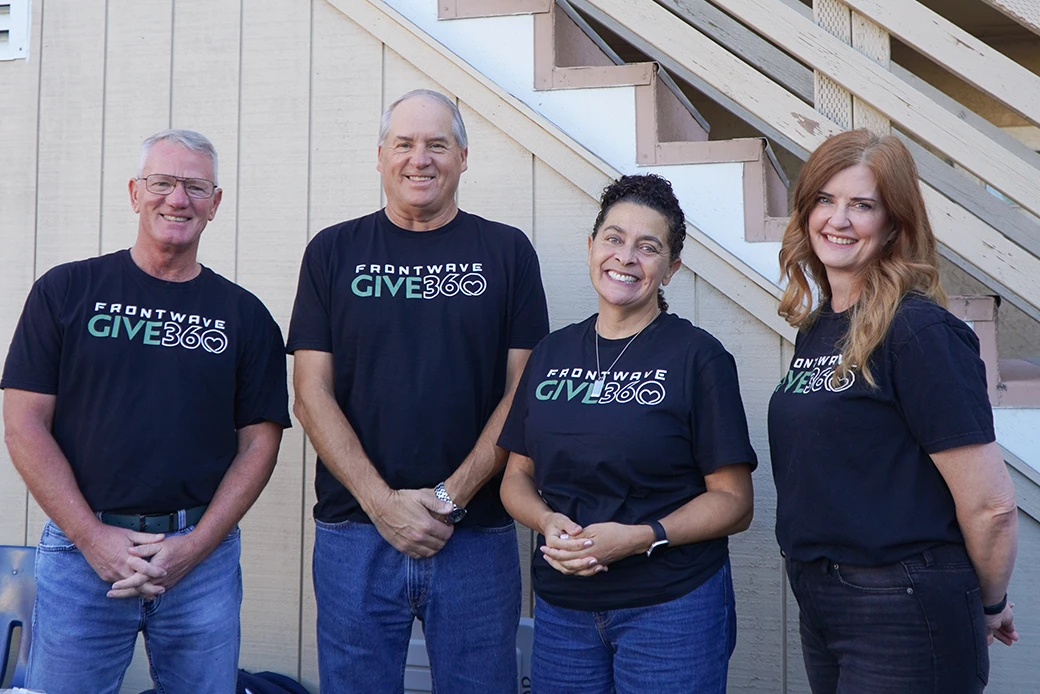
Showing Up for Our Communities
Through Frontwave Give360, we support local organizations and causes that strengthen the communities we call home.

This guide is built in sections. Pick the one that fits where you are right now and jump straight to it. There's no wrong place to start. Most people move through more than one stage over time, and what applies to you today might be different in six months.
Not sure which one fits? Start with the first. You can always move forward from there.
Focus on creating breathing room
Focus on building consistency.
Focus on making your money work harder.

When money feels stretched, the instinct is to look for a better system. A more detailed budget. A smarter plan. But most of the time, what actually helps first is something far more immediate: finding one small win and acting on it today.
This isn't about overhauling your finances. It's about proving to yourself that you can move money in the right direction and building from there.
Open your banking app right now and look at your last 30 days of transactions. You're looking for money you're spending that isn't doing anything for you. Here are three places it usually hides:
1. Streaming and subscription services. Most households are paying for two or three they don't actually use. A streaming service you haven't opened in six weeks. A premium app subscription that auto-renewed without you noticing. A gym membership that survives on guilt. Pick one. Cancel it or downgrade it today and move that money to savings. If you want more information, make sure to check out our Subscription Rehab blog.
2. Daily spending that adds up silently. A $6 coffee five days a week is $120 a month. A $14 lunch three times a week is $168 a month. Neither is wrong to spend. But if money is tight and you haven't looked at those numbers recently, it's worth taking a closer look and seeing the impact clearly. You don't have to eliminate them. Instead, make your favorite coffee at home or pack a lunch a couple times a week. Cutting either one in half changes the math significantly over 12 months.
3. Convenience spending. Delivery fees, last-minute purchases, impulse buys that felt small in the moment. These tend to be the easiest to reduce because they're the least intentional. Noticing them once makes you more likely to pause before the next one.
Once you find the money, move it into savings before you spend it. A $15 transfer that actually happens is worth more than a $200 savings plan you haven't started.
Reducing spending by $50 a month adds up to $600 over a year. That's the foundation of an emergency fund. A cushion that keeps the next unexpected expense from sending everything sideways.
You need somewhere for this first win to live. Open a separate savings account and label it "emergency fund." Even $25 set aside today changes the dynamic. Money you have to actively move is money you're less likely to spend by accident.
Keep the momentum moving by moving money over every payday and start building that healthy habit. With a few wins under your belt you can head to the next section and learn how to level up your savings.
Frontwave has certified financial counselors on staff, and our partners at GreenPath offer one-on-one coaching and financial guidance at no cost to members. If you're not sure where to start or what move makes the most sense for your situation, that's exactly what they're there for. You can call us at 800.736.4500, stop by a branch, or make an appointment.

You’ve already made the first move. Maybe you cut expenses, set money aside, or decided things needed to change. Now the focus shifts to making that decision automatic so it keeps working without you thinking about it.
The difference between people who save consistently and people who don’t usually isn’t income. It’s structure. The people who save have removed the decision entirely.
Before you pay a single bill, buy a single thing, or even glance at your balance, pay yourself first and move money directly to your savings account. If you don’t save first, there usually isn’t anything left to save before the next paycheck. Case in point: A recent study shows 66.5% of Americans are living paycheck to paycheck.
Want to make it stick? Set up an automatic transfer timed to your payday and let it run in the background. Start with whatever you think is sustainable and adjust as needed, even if that is just $50 a month. Making the consistent transfer every paycheck matters more than the amount. Remember, every marathon starts with that first step.
If you don’t have one yet, take a few minutes and open a separate savings account. Label it “emergency fund” so it’s clear what that money is for. If you already started, keep going. Now set a target so this has a finish line.
Experts agree you should aim to have three to six months of essential expenses covered. You don’t need to do any mental math to figure out that it is going to be a large number that might feel impossible to reach.
You can borrow a simple idea from video games to make this stick. In Level Up Your Life, Steve Kamb breaks big goals into levels so you always know what comes next.
Level theory turns one overwhelming goal into smaller milestones you can actually hit. A boss battle is the final challenge, where everything you’ve built comes together.
Now apply that to your emergency fund:
Level 1: Save your first $100
Level 2: Reach $500
Level 3: Hit $1,000
Level 4: Cover one month of expenses
Level 5: Cover three months of expenses
Boss Battle: Fully funded emergency fund (3 to 6 months of expenses)
And just like a video game, you might fail a level. An unexpected expense hits. You dip into savings. You have to start that level again. That’s not failure. That’s part of the game. You don’t lose your progress, you just reset and keep going.
Each level is a clear win. You hit it, you move up, you keep going. This turns saving from something vague into something you can track, build momentum around, and actually finish.
This is where knowledge starts paying off in dollars. Knowing the difference between a savings account and a money market account. What a certificate earns versus basic savings. When a Roth IRA makes more sense than a traditional IRA. These aren’t abstract ideas. They’re decisions that directly impact how fast your money grows and how much you keep.
If you’re not sure where to start, our Financial Education page is a good first step. Or skip the reading and talk to someone. Frontwave has certified financial counselors on staff, and our GreenPath partners offer free one-on-one coaching. Call 800.736.4500 or make an appointment.

The question now isn’t whether to save. It’s whether your money is in the right place.
For most people, it isn’t. A balance sitting in checking or a basic savings account might feel safe, but it’s not doing much. Over time, it works harder for the bank than it does for you.
Before anything else, make sure your foundation is covered. Do you have three to six months of essential expenses set aside and accessible? If not, that’s the priority. Everything that follows builds on that.
Once that base is in place, most people stall. The money sits, untouched, because it feels like the responsible thing to do.
Here’s the part most people miss. Your emergency fund doesn’t have to sit idle while you build it. You can structure it so part stays accessible while the rest works harder.
Now the real question. When do you need the money?
| Account | Access | Add to It? | Terms | Rate Tier |
|---|---|---|---|---|
| Money Market | Anytime | Yes | None | Higher than share savings, grows with balance |
| Savers Certificate | At maturity | Yes, $10 to $1,000/month | 6, 12, 24, 36 months | Fixed, higher than money market |
| Share Certificate | At maturity | No | 6, 12, 18, 24, 36, 48, 60 months | Fixed, highest available |
| IRA | Retirement age | Yes, up to annual limits | Long-term | Tax-advantaged growth |
Keep it accessible. Make it earn more. A Money Market Account pays more than a basic savings account while keeping your money available. No lockups or penalties. Money Market Accounts use tiered rates. The more you keep in the account, the more you earn. For most people, this is the first upgrade from basic savings.
Commit to a term. Earn the highest rate. A Share Certificate works like a CD, letting you lock in a guaranteed return to take the guesswork out of growing your money. Start with as little as $1,000 and let it grow for 6 to 60 months. For example, Frontwave's 6-month Share Certificate currently earns 3.25% APY.1 Share Certificates are best for a lump sum with a clear timeline. There are early withdrawal penalties, so make sure to refer to your certificate receipt for all the details.
Lock in a rate. Keep building. A Savers Certificate lets you start with as little as $100, lock in a fixed rate higher than your standard savings account and make a set monthly deposit. You commit to a timeline but continue growing the balance. It’s not something every financial institution offers, and it’s one of the ways Frontwave helps you keep building without slowing down. Frontwave's 12-month Savers Certificate currently earns 0.75% APY.2 These are a great way to enjoy the benefits of a share certificate with the flexibility of a traditional savings account.
Split it up. Keep something coming due. Ladder your certificates across staggered maturity dates. Instead of just putting everything into one timeline, spread it out over several certificates with different terms. like 6, 12, and 24 months. As each one matures, you can reinvest or use the funds. Although the rates can vary, the advantage of laddering is flexibility. Your money keeps earning, and a portion becomes available at regular intervals, giving you access without penalty.
Start early. Let time do the work. Retirement accounts aren’t just about saving more. They’re about keeping more of what you earn. A Roth IRA grows tax-free, with qualified withdrawals also tax-free in retirement. A Traditional IRA may reduce your taxable income now, with taxes paid later.
If you're not sure which path is best for you, Frontwave's team is there for to walk you through all these options. You can call us at 800.736.4500, stop by a branch, or make an appointment.

Most of us didn’t really learn about money until we messed something up. The goal with kids is to give them a place to learn before it actually costs them.
A lot of adults still feel unsure about money, and it usually comes back to one thing. No one talked about it growing up. It just wasn’t part of everyday life. That’s the part you can change.
You don’t need to have it all figured out. Just start earlier than someone did for you. Let them see how money works. Let them make small calls. Let them save for something they actually care about and feel what it’s like to wait.
Frontwave’s youth accounts are built around that idea. No monthly fees. You stay connected on the account. And it grows with them as they get older.
Student Savings and Student Checking accounts give younger kids a real account with real stakes. The savings account earns dividends from day one, with a low opening deposit to make it easy to start. Parents are joint owners throughout, staying connected to every transaction and guiding decisions as they happen. At 13, the account automatically upgrades to Teen Savings. No action required.
Teen accounts are built on the same foundation but with more independence built in. Teen Savings earns dividends, pairs with a Teen Checking account and a Visa debit card, and gives teenagers real experience managing money with mobile banking, while parents retain joint ownership and visibility. At 18, the account converts to a standard Share Savings account, so the transition to adult banking is seamless rather than a disruption.
A teenager who has watched their own balance grow is far more likely to set up an automatic transfer at 22 than someone encountering the idea for the first time. That's the real return on a Teen Savings account.
Youth accounts require a branch visit to open. You can find a location near you or schedule an appointment ahead of time.

Whether you’re finding your first $25, setting up automatic transfers, or building toward retirement, the challenge is the same. It’s not getting started. It’s keeping momentum when life inevitably gets in the way.
Money gets tight. Something unexpected comes up. A habit slips for a month. That’s not failure. That’s what saving actually looks like in real life. The goal isn’t perfection. It’s having a structure in place so one interruption doesn’t erase everything you’ve built.
That’s where this shifts. Structure beats motivation.
When you set transfers to happen on payday, keep savings in a separate account, and give each dollar a clear role, you’re building a system that holds up even when motivation drops. Most saving problems aren’t about discipline. They come down to design. How your accounts are set up, how money moves, and how easy it is to access all shape the outcome. When you change the structure, the results usually follow.
So let’s walk through where this breaks down and what actually fixes it.
When everything lives in one place, it all gets treated the same. There’s no real separation between money you meant to protect and money you’re willing to spend, so it slowly gets absorbed into everyday life.
The fix is simple and it works. Open a dedicated savings account and move money there on payday before you spend anything. That separation creates both a practical and psychological boundary. Out of sight isn’t a trick. It’s a system that consistently outperforms willpower.
For most people, there isn’t anything left over. When saving is the last thing that happens in a month, every other decision competes with it, and spending usually wins.
The shift is to reverse the order. Save first, on payday, automatically, then spend what remains. That single change removes the daily decision-making and replaces it with a system that runs in the background.
Savings without a purpose rarely stay intact. When you can’t clearly say what the money is for, it always feels available.
Give it a job. It could be an emergency fund, a car repair buffer, a trip, or a future down payment. The goal doesn’t have to be perfect, but it does need to be defined enough that the money feels protected. That clarity changes how you treat it.
When money is always one tap away, it tends to get used. Not because of bad decisions, but because there’s no friction.
Adding a small amount of separation helps. That could be a different account, a slight delay, or simply keeping funds somewhere you don’t check every day. The goal isn’t to make your money hard to reach in an emergency. It’s to make it slightly harder to reach when you don’t actually need it.
This is where momentum usually breaks. One missed month, one unexpected expense, or one stretch where saving stops can feel like starting from scratch.
But it’s not. It’s an interruption.
The accounts are still there. The system can be restarted. A setback resets your balance, not your progress. The only thing that truly stops momentum is deciding not to continue.
Saving isn’t about getting everything right. It’s about building a system that keeps working even when things go wrong. When your setup is doing the heavy lifting, consistency becomes easier, and progress becomes more durable.
And once that structure is in place, the next question becomes a lot more interesting.
Where should that money actually go?
And if you're not sure what your next move should be? That's exactly the kind of question Frontwave's certified financial counselors and GreenPath partners are there for. One conversation can save you months of guessing. Call us at 800.736.4500, stop by a branch, or make an appointment.
If you’re not yet a Member, opening a Share Savings account is where most people begin. It takes about 10 minutes online and gives you access to everything that follows.
Start there. Open your account and explore the savings options that fit your timeline, whether that’s a Money Market, a Certificate, or an IRA.
If you want to understand what sets Frontwave apart, take a minute to see how we show up for our Members and why more people are making the switch.
If you’re already a member, focus on your next step. Build your emergency fund, set up automatic transfers, or move money into the account that fits where you’re headed.
Remember, saving money isn’t about finding the perfect plan. It’s about making one move and building from there.